> ## Documentation Index
> Fetch the complete documentation index at: https://pinata-mintlify-5df45191.mintlify.site/llms.txt
> Use this file to discover all available pages before exploring further.
# Agent channels: Telegram, Slack, Discord
> Connect your Pinata agent to Telegram, Slack, or Discord so users can chat with it directly from the messaging apps they already use.
By default, the only way to talk to your agent is through the Pinata dashboard. Channels change that — connect Telegram, Slack, or Discord, and your agent shows up wherever you and your team already chat.
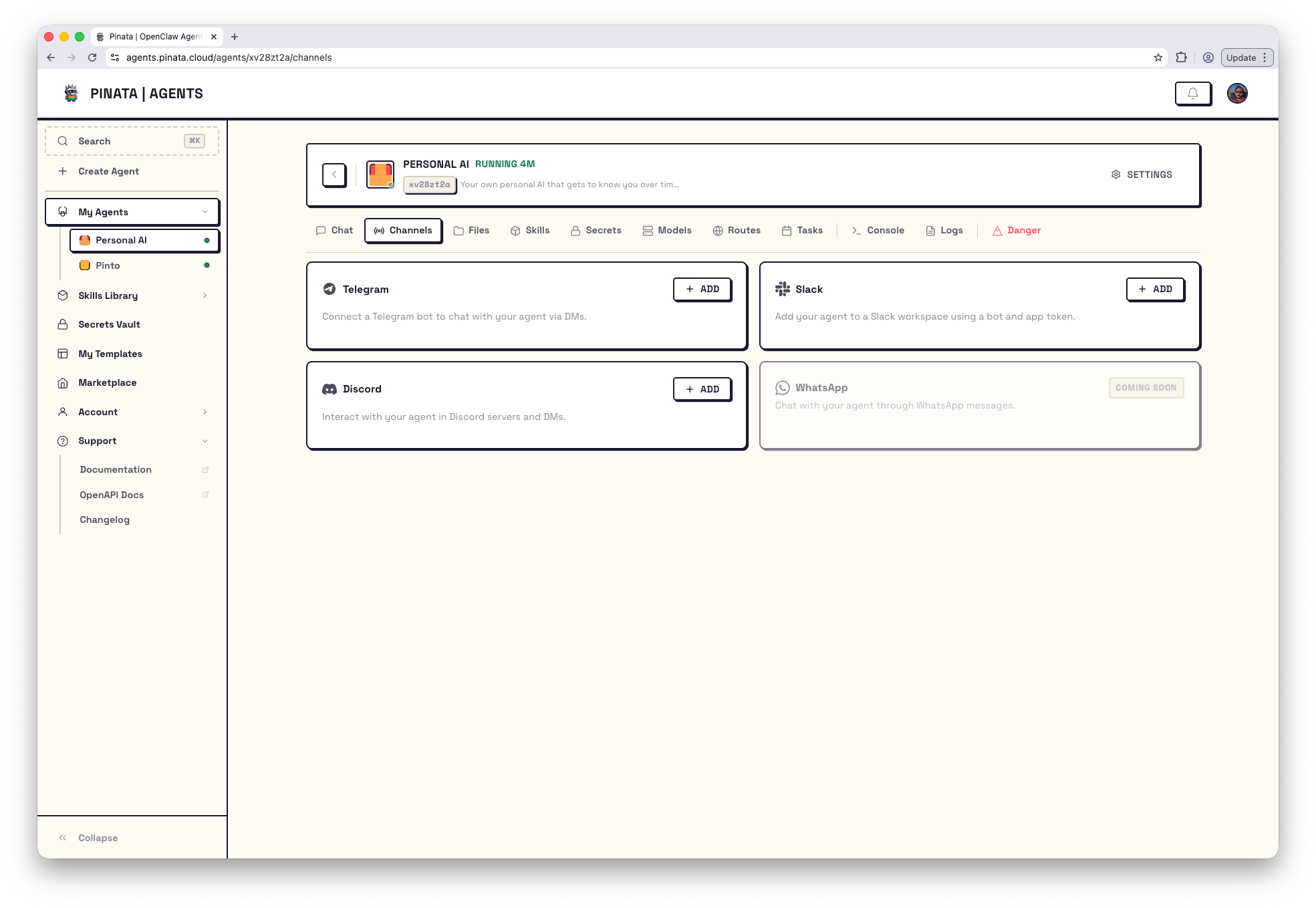
WhatsApp is on the roadmap; you'll see its card grayed out as **Coming Soon**.
 ## How it works
Open your agent → **Channels**. You'll see one card per platform.
* A card with **+ ADD** isn't connected yet. Click it to open the setup dialog.
* A card with **ENABLED** is already connected. The card shows a summary (the DM policy and a masked bot token), and a **RECONFIGURE** button reopens the dialog so you can update settings without losing the connection.
Setup is the same shape for every platform: grab a bot token from the platform, paste it into the dialog, save. Some platforms need an extra token or an OAuth invite to a workspace/server.
Once a channel is enabled, anyone who messages your bot on that platform is talking to your agent. Responses come back through the same channel.
## Telegram
This is the quickest. You need a bot token from Telegram's BotFather.
1. In Telegram, message [@BotFather](https://t.me/botfather)
2. Send `/newbot` and follow the prompts
3. Copy the bot token BotFather gives you
4. In Pinata: agent → **Channels** → **+ ADD** on the Telegram card
5. Paste the token and save
### Controlling who can DM your bot
The Telegram dialog has two access controls:
* **DM policy** — `open` (anyone can message) or `pairing` (users must be approved first)
* **Allow list** — a list of Telegram user IDs that are allowed to message
You can use either or both. Leave both at their defaults if you want anyone to be able to chat.
## Slack
Slack needs a custom app with the right permissions. It's a few more steps but everything happens once.
1. Go to [api.slack.com/apps](https://api.slack.com/apps) and create a new app
2. Enable **Socket Mode**
3. Create an **App-Level Token** with the `connections:write` scope
4. Under **OAuth & Permissions**, add these bot token scopes: `chat:write`, `im:write`, `im:history`, `im:read`, `users:read`, `app_mentions:read`
5. Install the app to your workspace
6. In Pinata: agent → **Channels** → **+ ADD** on the Slack card
7. Paste both tokens — bot token starts with `xoxb-`, app token starts with `xapp-`
Once connected, the bot responds to DMs and to `@mentions` in any channel it's been invited to.
## Discord
Same shape as Telegram — make a bot in Discord's developer portal, copy the token, paste it in.
1. Go to [discord.com/developers](https://discord.com/developers/applications) and create an application
2. Under **Bot**, click **Add Bot** and copy the token (you may need to reset it once to reveal it)
3. Under **OAuth2 → URL Generator**, check the `bot` scope and the permissions your bot needs
4. Open the generated URL to invite the bot to your server
5. In Pinata: agent → **Channels** → **+ ADD** on the Discord card
6. Paste the bot token and save
## Updating or removing a channel
* **Reconfigure** — click **RECONFIGURE** on an enabled channel. You can leave the token fields blank to keep the existing token while changing other settings.
* **Remove** — same dialog, **Remove** action. This deletes the channel config and restarts the agent's gateway.
Channels are available for chat-oriented engines such as OpenClaw and Hermes. Channel changes take effect after the gateway restarts; Configure and Remove handle that automatically. The create wizard can collect channel setup before deployment. If you're creating an agent via the API or CLI, pass a `channels` object on `POST /v0/agents` for engines that support create-time channel bootstrap — see [API → Create an agent](/agents/api#create-an-agent).
Bot tokens are sensitive. Keep them out of source control. They're stored encrypted on Pinata's side; treat them the same way locally.
## When it doesn't work
| Symptom | What's going on | What to do |
| ----------------------------------- | -------------------------------------------------- | -------------------------------------------------------------------------------- |
| Bot doesn't respond | Gateway didn't restart after configure | Open **Danger** → **Restart Gateway** |
| Slack works in DMs but not channels | Missing `app_mentions:read` scope | Reinstall the Slack app with the scopes above |
| Telegram users get no reply | `dmPolicy` is `pairing` and they aren't paired yet | Switch to `open`, or approve them via [Devices](/agents/devtools#device-pairing) |
| `403` when adding a channel | Plan limit or workspace permissions | Check your plan and workspace role |
If none of these match, check [Logs](/agents/logs) for entries from `gateway/reload` and the channel name, or walk through [Troubleshooting](/agents/troubleshooting).
## How it works
Open your agent → **Channels**. You'll see one card per platform.
* A card with **+ ADD** isn't connected yet. Click it to open the setup dialog.
* A card with **ENABLED** is already connected. The card shows a summary (the DM policy and a masked bot token), and a **RECONFIGURE** button reopens the dialog so you can update settings without losing the connection.
Setup is the same shape for every platform: grab a bot token from the platform, paste it into the dialog, save. Some platforms need an extra token or an OAuth invite to a workspace/server.
Once a channel is enabled, anyone who messages your bot on that platform is talking to your agent. Responses come back through the same channel.
## Telegram
This is the quickest. You need a bot token from Telegram's BotFather.
1. In Telegram, message [@BotFather](https://t.me/botfather)
2. Send `/newbot` and follow the prompts
3. Copy the bot token BotFather gives you
4. In Pinata: agent → **Channels** → **+ ADD** on the Telegram card
5. Paste the token and save
### Controlling who can DM your bot
The Telegram dialog has two access controls:
* **DM policy** — `open` (anyone can message) or `pairing` (users must be approved first)
* **Allow list** — a list of Telegram user IDs that are allowed to message
You can use either or both. Leave both at their defaults if you want anyone to be able to chat.
## Slack
Slack needs a custom app with the right permissions. It's a few more steps but everything happens once.
1. Go to [api.slack.com/apps](https://api.slack.com/apps) and create a new app
2. Enable **Socket Mode**
3. Create an **App-Level Token** with the `connections:write` scope
4. Under **OAuth & Permissions**, add these bot token scopes: `chat:write`, `im:write`, `im:history`, `im:read`, `users:read`, `app_mentions:read`
5. Install the app to your workspace
6. In Pinata: agent → **Channels** → **+ ADD** on the Slack card
7. Paste both tokens — bot token starts with `xoxb-`, app token starts with `xapp-`
Once connected, the bot responds to DMs and to `@mentions` in any channel it's been invited to.
## Discord
Same shape as Telegram — make a bot in Discord's developer portal, copy the token, paste it in.
1. Go to [discord.com/developers](https://discord.com/developers/applications) and create an application
2. Under **Bot**, click **Add Bot** and copy the token (you may need to reset it once to reveal it)
3. Under **OAuth2 → URL Generator**, check the `bot` scope and the permissions your bot needs
4. Open the generated URL to invite the bot to your server
5. In Pinata: agent → **Channels** → **+ ADD** on the Discord card
6. Paste the bot token and save
## Updating or removing a channel
* **Reconfigure** — click **RECONFIGURE** on an enabled channel. You can leave the token fields blank to keep the existing token while changing other settings.
* **Remove** — same dialog, **Remove** action. This deletes the channel config and restarts the agent's gateway.
Channels are available for chat-oriented engines such as OpenClaw and Hermes. Channel changes take effect after the gateway restarts; Configure and Remove handle that automatically. The create wizard can collect channel setup before deployment. If you're creating an agent via the API or CLI, pass a `channels` object on `POST /v0/agents` for engines that support create-time channel bootstrap — see [API → Create an agent](/agents/api#create-an-agent).
Bot tokens are sensitive. Keep them out of source control. They're stored encrypted on Pinata's side; treat them the same way locally.
## When it doesn't work
| Symptom | What's going on | What to do |
| ----------------------------------- | -------------------------------------------------- | -------------------------------------------------------------------------------- |
| Bot doesn't respond | Gateway didn't restart after configure | Open **Danger** → **Restart Gateway** |
| Slack works in DMs but not channels | Missing `app_mentions:read` scope | Reinstall the Slack app with the scopes above |
| Telegram users get no reply | `dmPolicy` is `pairing` and they aren't paired yet | Switch to `open`, or approve them via [Devices](/agents/devtools#device-pairing) |
| `403` when adding a channel | Plan limit or workspace permissions | Check your plan and workspace role |
If none of these match, check [Logs](/agents/logs) for entries from `gateway/reload` and the channel name, or walk through [Troubleshooting](/agents/troubleshooting).